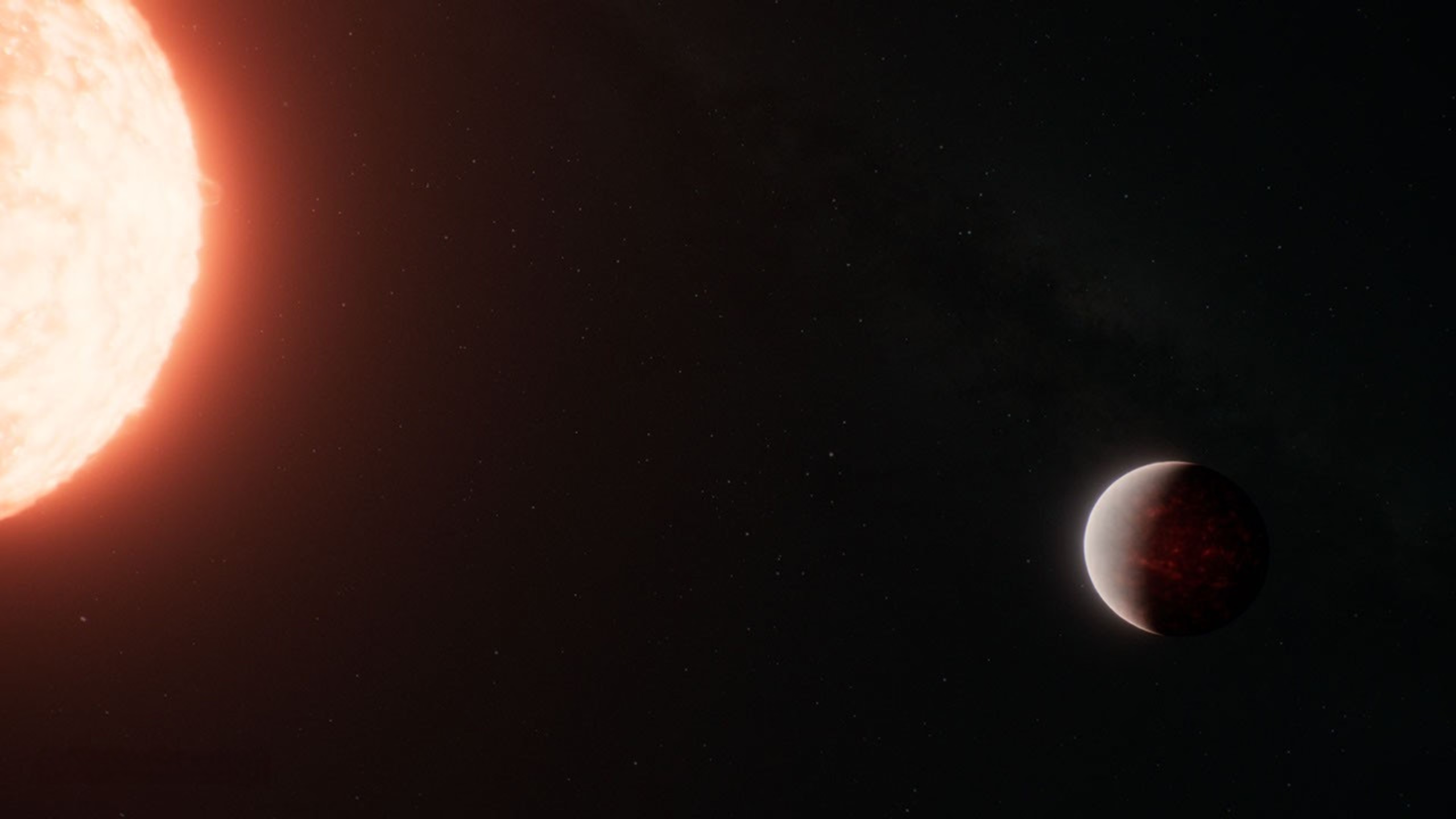
It’s been a while since the James Webb Space Telescope last delivered a jaw-dropping discovery, but this one was worth the patience. Astronomers now have the strongest evidence yet that a rocky planet beyond our solar system has an atmosphere. That alone is a big deal, and the planet in question is anything but ordinary.
Meet TOI-561 b, a World That Orbits in a Blink
Webb recently spent more than 37 uninterrupted hours staring at an ultra-hot super-Earth called TOI-561 b as part of its General Observers Program 3860. This planet sits about 280 light-years away in the constellation Sextans and races around its star once every 11 hours. Yes, hours, not days.
TOI-561 b is the innermost of four planets orbiting an ancient, 10-billion-year-old star known as TOI-561. With a radius about 1.4 times that of Earth, it belongs to a rare group of planets astronomers call ultra-short-period exoplanets.
A Rocky Planet in a Brutal Neighborhood
This world lives dangerously close to its star, less than a million miles away. That’s roughly one-fourth the distance between Mercury and our Sun. Conditions there are extreme, far beyond anything life as we know it could tolerate.
Scientists believe the planet is tidally locked, always showing the same face to its star. On that permanent dayside, temperatures soar past the melting point of most rock. None of this shocked astronomers. What did surprise them was the planet’s density.
A Strange Density Raises Big Questions
TOI-561 b appears less dense than expected for a rocky world. That hints at a small iron core and a mantle made of unusually light rock. Another intriguing possibility quickly followed: maybe the planet looks larger than it really is because it’s wrapped in a thick atmosphere.
That idea is exactly what pushed scientists to take such a long, detailed look with Webb. And as it turns out, their hunch was right.
Webb Spots Signs of an Atmosphere
A research team led by Johanna Teske from Carnegie Science’s Earth and Planets Laboratory confirmed the presence of an atmosphere in a study published in The Astrophysical Journal Letters. Using Webb’s Near-Infrared Spectrograph, the team measured the planet’s brightness and determined the temperature on its dayside.
The result came in at about 3,200 degrees Fahrenheit, or 1,800 degrees Celsius. That’s blisteringly hot, yet still far cooler than the nearly 4,900 degrees Fahrenheit scientists expected given how close the planet is to its star.
A Thick, Exotic Blanket of Gas
To explain this mismatch, the researchers say the planet must have a thick, volatile-rich atmosphere. Strong winds could be moving heat from the scorching dayside to the cooler nightside, effectively acting as a planetary air conditioner.
This atmosphere may contain water vapor, other gases, and even vaporized rock, something that can exist under such extreme temperatures and pressures. Some wavelengths of infrared light may be absorbed before escaping the surface, and reflective silicate clouds could also be bouncing starlight back into space.
A Planet That Breathes Lava
According to co-author Tim Lichtenberg from the University of Groningen, there may be a constant exchange happening between the planet’s atmosphere and a global magma ocean below.
He describes it as a kind of balance, where gases rise from the molten surface to form the atmosphere, while at the same time the magma pulls those gases back into the planet’s interior. To match what Webb is seeing, TOI-561 b would have to be far richer in volatile materials than Earth.
In simple terms, it’s less like a dry rock and more like a wet lava ball floating through space.
More Answers, and Even More Mysteries
An atmosphere helps explain the planet’s odd density, but it also opens the door to new puzzles. One of the biggest is how such a relatively small planet manages to hold onto an atmosphere under such brutal conditions.
The research team is already working on that question. They’re also analyzing the full data set from Webb to map temperatures around the entire planet, which could reveal exactly what this alien atmosphere is made of.
A Window Into the Early Universe
TOI-561 b’s strangeness may come from its origins. It orbits one of the oldest, iron-poor stars known, located in a part of the Milky Way called the thick disk. That means it likely formed in a very different chemical environment than the planets in our own solar system.
Because of that, this world could tell us a great deal about how planets formed when the universe was still young. In that sense, TOI-561 b may be far more important than its hellish surface suggests.
The Discoveries Are Just Getting Started
While TOI-561 b is fascinating, it’s only a taste of what’s coming. Several powerful telescopes are preparing to explore alien worlds in even greater detail, including the Nancy Grace Roman Space Telescope, which is expected to uncover around 100,000 new planets.
So yes, the strongest evidence yet for an atmosphere on a rocky exoplanet is exciting. But if history has taught us anything, it’s that even bigger, mind-blowing discoveries are waiting just around the corner.
Source: NASA