If you’ve been following the rapid rise of humanoid robots, you already know that many of them aren’t fully autonomous yet. Behind those smooth movements and eerily human gestures, there’s often a real person doing the hard work. Companies like Unitree rely on human operators to guide their humanoid robots through complex tasks, especially during training and demonstrations. It’s a fascinating blend of human intelligence and mechanical precision but as one recent demo proved, it can also be hilariously unforgiving.
At the heart of this setup is something called full-body motion capture. The operator suits up in specialized gear, covered in sensors that track every shift of weight, every bend of a knee, and every swing of an arm. All of that data is streamed to the robot in real time. The robot doesn’t interpret or “think” about what the human is doing. It simply mirrors it. Move your arm, the robot moves its arm. Lift your leg, the robot lifts its leg. It’s a direct, almost brutally honest reflection.
Most of the time, this works beautifully. Sometimes, though, it works a little too well.
Demo That Went Sideways
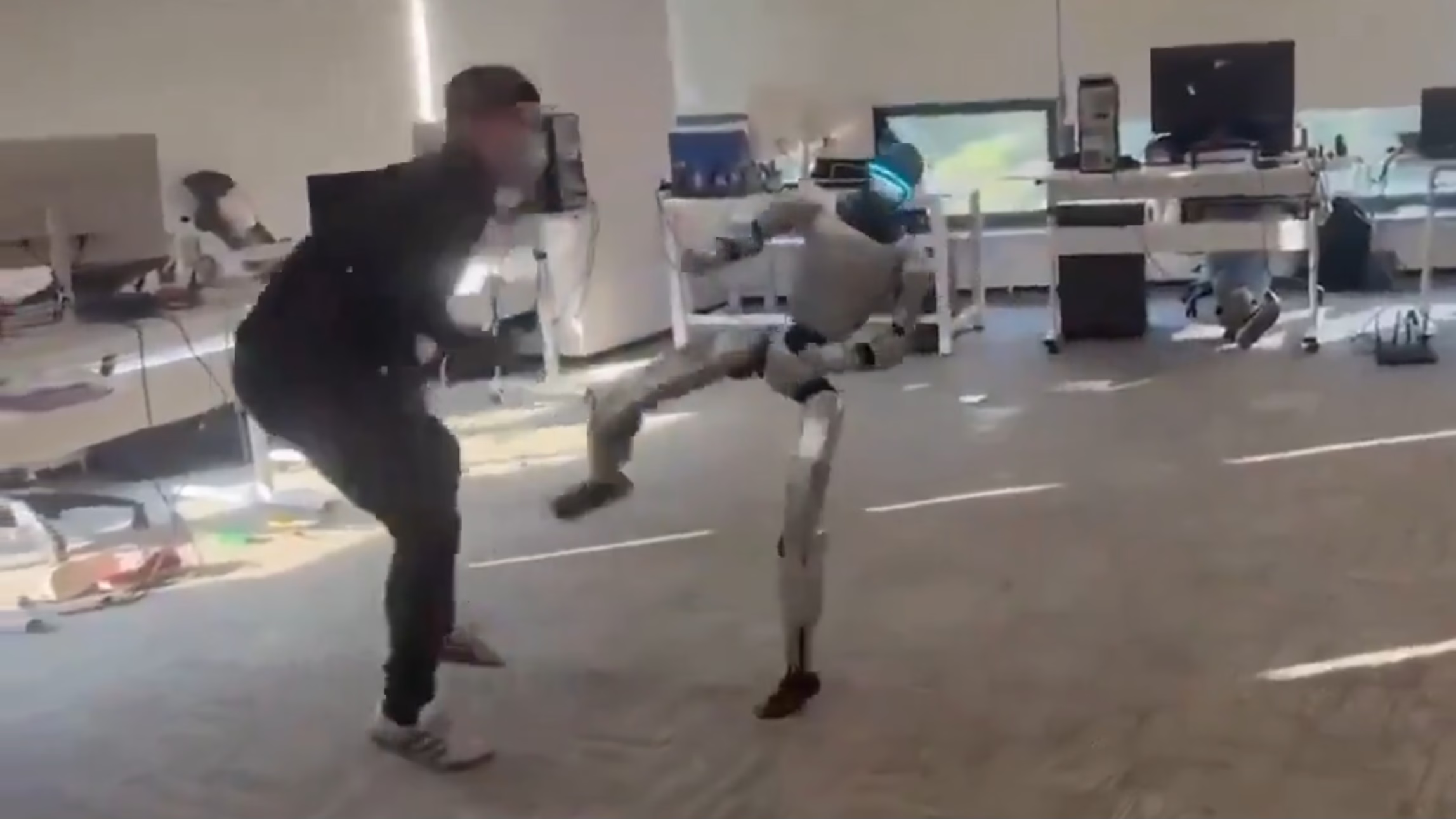
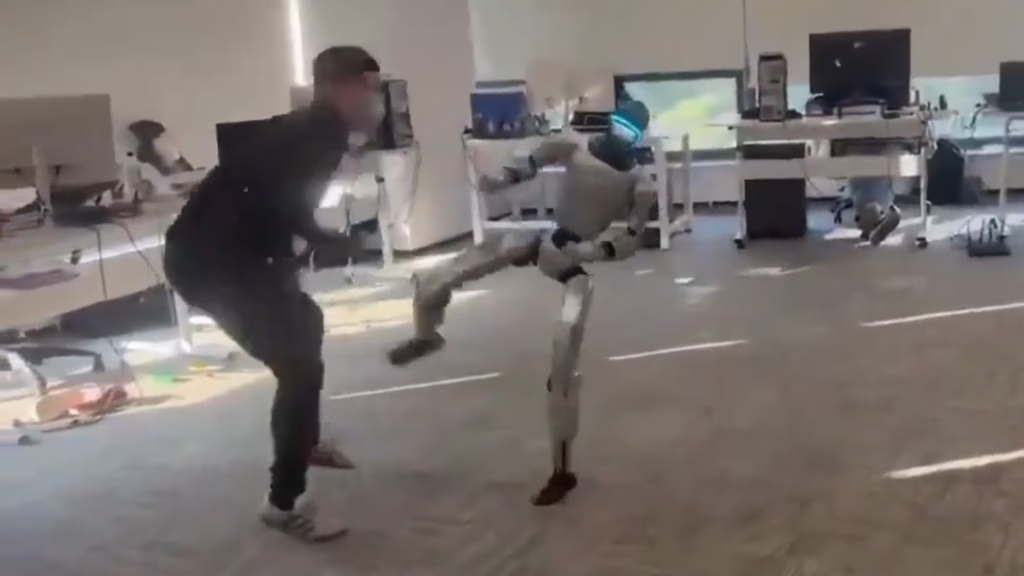
During a recent public demonstration involving a Unitree G1 humanoid robot, one operator learned a very painful lesson about perspective, angles, and unintended consequences. Wearing what appeared to be an XSENS motion capture suit, he decided to spice things up by showing off a few martial arts-inspired moves.
From the outside, it probably seemed harmless enough. After all, demos are meant to impress. Robots mimicking athletic or combat-style movements are always crowd-pleasers, and showing off balance, flexibility, and responsiveness is part of the job. So the operator squared up and prepared to kick the robot low, presumably to demonstrate how the robot could respond to a sudden or aggressive motion.
Here’s where things went wrong in the most unfortunate way possible.
When Mirroring Becomes Merciless
The key detail that sealed this man’s fate is simple: both the human and the robot were facing the same direction. They weren’t squared off against each other like two sparring partners. They were aligned, side by side, looking forward.
In a motion capture setup like this, the robot doesn’t understand intent. It doesn’t know you’re trying to kick it. It only knows that your leg is rising. So when the operator lifted his leg, the robot lifted its leg too. Perfectly. Faithfully. Without hesitation.
The operator’s foot never came anywhere near the robot. Instead, it continued its upward arc and slammed directly into his own crotch.
The Split Second Between Confidence and Regret
There’s a brief moment in situations like this usually just a fraction of a second, where reality catches up to confidence. Witnesses say that moment was visible on his face. What began as a controlled, deliberate motion turned into instant regret as pain took over.
He collapsed almost immediately, dropping to the ground like a sack of bricks. Clutching his midsection, he folded in on himself, his face contorted in unmistakable agony. Anyone who’s ever taken an accidental hit in that area doesn’t need an explanation of just how brutal that pain can be. Behind him, the crowd did what crowds tend to do in moments like these. They laughed Loudly.
The Robot That Bowed in Sympathy or Mockery
If the story had ended there, it would’ve been embarrassing enough. But the robot wasn’t done playing its role in this accidental comedy.
As the operator knelt on the floor trying to recover, the Unitree G1 continued doing exactly what it was designed to do: mirror the human. When the man bent forward, the robot bent forward too. When he slumped, so did the machine.
To onlookers, it looked almost poetic. The robot appeared to bow in sympathy, as if it were sharing in the pain. Others joked that it looked like the robot was mocking him, silently saying, “I felt that too.” Either way, the visual was too perfect not to go viral.
Within hours, clips of the incident were spreading online, racking up views and comments from amused viewers around the world.
Why Motion Capture Is Both Brilliant and Brutal
As funny as this incident is, it also highlights an important truth about how humanoid robots are trained today. Motion capture is incredibly effective because it allows robots to learn complex movements quickly and accurately. Walking, running, crouching, recovering from a stumble, and even adopting combat stances can all be taught far more efficiently by copying a human than by coding every movement from scratch.
The downside is that robots don’t have common sense. They don’t know what’s safe, what’s risky, or what’s downright foolish. If a human does it, the robot will too, regardless of whether the context makes sense.
That’s why operators usually practice these routines carefully, with strict attention to positioning and orientation. When those details are overlooked, the system doesn’t forgive the mistake. It executes it perfectly.
Training Sessions Usually Go Smoothly
It’s worth pointing out that incidents like this are rare. Thousands of motion capture sessions happen without any issues at all. Operators are trained professionals who understand the limitations and quirks of the technology. They know when to face the robot, when to offset their position, and when to avoid exaggerated or aggressive movements.
These training exercises are a critical part of developing humanoid robots that can function in real-world environments. Learning how to regain balance after a shove, how to move quickly without falling, or how to assume defensive postures are all essential skills for robots designed to work alongside humans.
In most cases, everything goes exactly as planned. This demo stood out precisely because it didn’t.
A Lesson in Perspective
The core lesson here isn’t “don’t show off” or “don’t trust robots.” It’s much simpler than that. Perspective matters. When you’re controlling a machine that mirrors you perfectly, direction and orientation aren’t minor details. They’re everything.
If the operator had been facing the robot, the kick might have looked dramatic without being disastrous. Facing the same way turned his own body into the unintended target.
It’s a reminder that as advanced as our technology becomes, human error still plays a starring role in how things unfold.
Picking Himself Up
Eventually, the operator managed to straighten himself up. He was clearly still sore, moving carefully and wearing the unmistakable expression of someone who knows they’re going to be feeling this mistake for a while. There was likely a bruised ego to go along with whatever physical pain he was nursing.
The robot, on the other hand, stood patiently, waiting for the next command. It hadn’t done anything wrong. It simply followed instructions exactly as designed.
In a strange way, that contrast is what makes the moment so memorable. The human made a very human mistake. The robot executed its role flawlessly.
Why We Can’t Stop Watching Moments Like This
Part of why this clip resonated so strongly online is because it sits right at the intersection of cutting-edge technology and slapstick comedy. We tend to think of robots as futuristic, precise, and almost sterile. Seeing them involved in a painfully human blunder makes them feel more relatable, even endearing.
It also serves as a gentle reminder that no matter how advanced our machines become, they’re still tools. Powerful tools, yes, but ones that reflect our actions back at us without judgment or mercy.
The Takeaway: Respect the Mirror
As humanoid robots become more common, we’re likely to see more moments like this, hopefully with less pain involved. Motion capture remains one of the most powerful ways to teach robots how to move like us, but it demands respect and careful handling.
If nothing else, this incident will probably be remembered as a cautionary tale for future demos. When you’re wearing a motion capture suit and standing next to a humanoid robot, remember one thing: it’s always watching, always copying, and it has no idea when you’re about to make a very bad decision.
Sometimes, the hardest lessons are the ones that hit closest to home, literally.