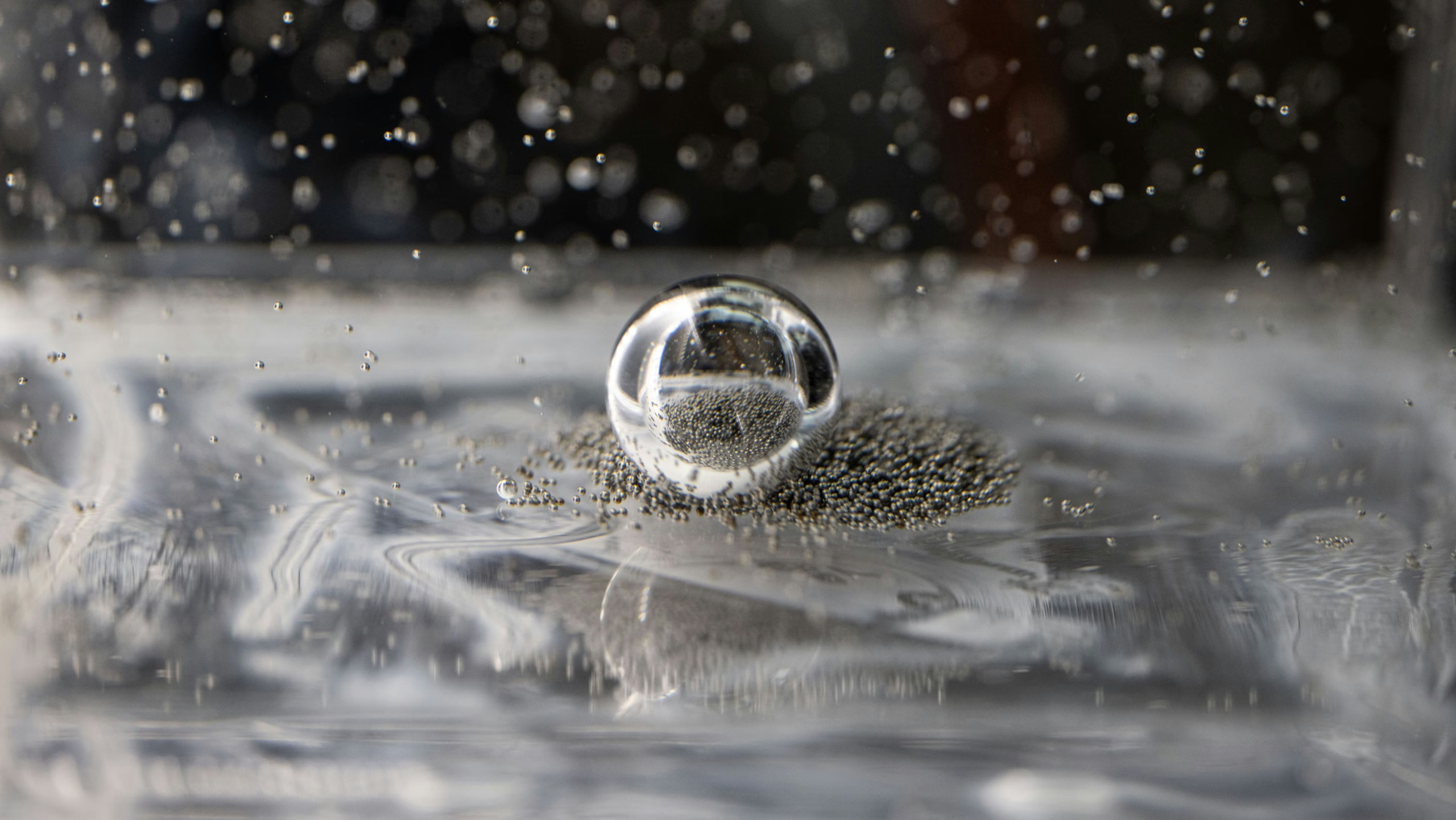
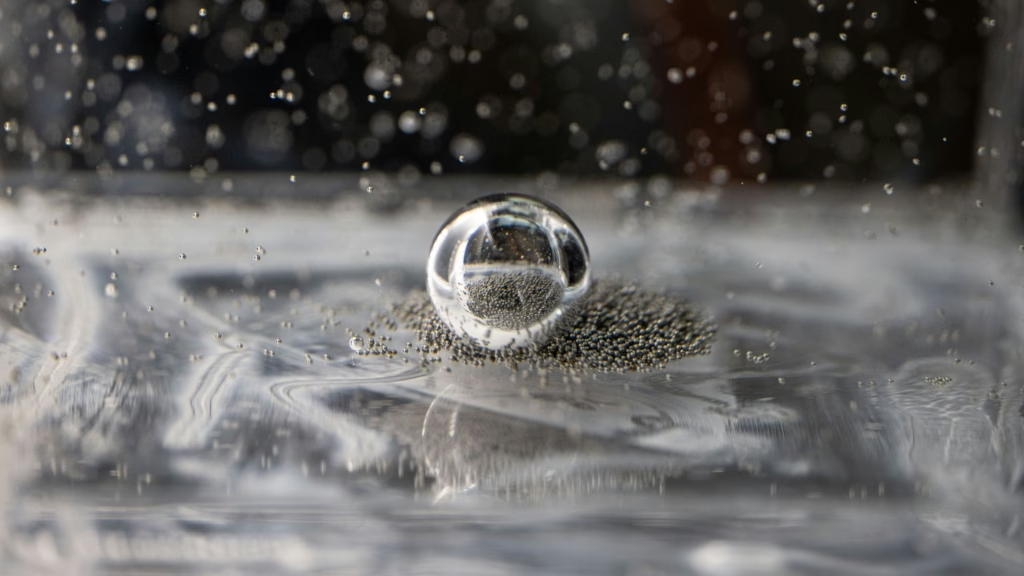
When we imagine science aboard the International Space Station, it is easy to picture complex machines, glowing screens, and astronauts performing advanced procedures. But sometimes, the most revealing experiments look surprisingly simple. A recent moment inside the ISS showed something almost poetic. A handful of tiny metal ball bearings gently drifting around a larger one, all suspended in a thick liquid, calmly responding to movements so small they would barely register back on Earth.
At first glance, it might seem like a curious space novelty. In reality, it is a powerful demonstration of how much gravity normally hides from us and how removing it allows scientists to observe forces that quietly shape everything from space exploration to environmental systems on Earth.
A Unique Laboratory Floating Above Earth
This experiment takes place inside the Destiny laboratory module, one of the main science areas aboard the ISS. Within Destiny sits the Microgravity Science Glovebox, a compact and sealed workstation designed to keep astronauts safe while they handle materials that would otherwise drift freely through the station.
The glovebox functions like a small lab inside a larger one. Astronauts place their hands into built in gloves and carefully adjust equipment without releasing particles into the station atmosphere. For the Fluid Particles experiment, the setup includes a clear container filled with a dense liquid and a mixture of components, including metal ball bearings of different sizes.
Once the container is secured, astronauts gently move it back and forth. There is no vigorous shaking or spinning. Instead, the motions are slow and controlled. After that, the astronauts observe patiently as the particles respond.
Why Space Shows Us What Earth Hides
On Earth, gravity dominates nearly every physical process. Objects fall, liquids settle, and materials separate according to weight. Heavier substances sink while lighter ones float. These familiar effects make it extremely difficult to observe the weaker forces that also influence how particles interact.
Those weaker forces still exist on Earth, but gravity overwhelms them. It pulls everything downward and forces materials into predictable layers. As a result, scientists struggle to isolate and study the subtle interactions happening between particles inside fluids.
In the microgravity environment of the ISS, that dominance disappears. Particles no longer rush to the bottom or float to the top. Instead, they are free to move in response to much gentler influences. Scientists can finally watch how particles attract, repel, cluster, and rearrange themselves without gravity dictating the outcome.
This creates a clearer and more detailed view of physics at work on a small scale.
The Gentle Motion of Floating Spheres
Inside the container, the ball bearings begin to behave in ways that would be impossible to observe on Earth. Smaller spheres drift around larger ones. Some move closer and briefly stick together, while others keep a careful distance. Over time, clusters form and patterns appear, sometimes settling into stable arrangements that persist for long periods.
What makes this especially fascinating is how sensitive the system is. Very small vibrations are enough to trigger motion. Movements that would be meaningless on Earth suddenly become powerful drivers of change in space.
By closely tracking how these particles behave, scientists can see how order emerges from gentle motion. Even without gravity, physical systems still organize themselves according to fundamental rules.
Improving Fire Safety for Astronauts
One of the most important practical applications of this research involves fire safety in space. Fire behaves very differently without gravity. Flames do not rise the way they do on Earth, and smoke does not naturally drift upward and away from people.
Fire suppression systems aboard spacecraft often rely on tiny particles that spread through the air to interrupt combustion. However, if those particles clump together or fail to distribute evenly, the system may not work as intended.
The Fluid Particles experiment helps scientists understand how particles move and group together in low gravity environments. This knowledge can be used to design more reliable fire suppression systems that perform consistently even when gravity is no longer present to assist.
Ensuring astronaut safety during long missions depends on understanding these details.
Controlling Dust on the Moon and Beyond
The same research also applies to one of the biggest challenges of returning to the Moon. Lunar dust is extremely fine, abrasive, and clingy. During earlier missions, it coated spacesuits, instruments, and spacecraft interiors, causing wear and health concerns.
As future missions plan for longer stays on the Moon, controlling dust becomes essential. Understanding how particles behave in reduced gravity can help engineers develop better strategies to limit dust movement during landings, surface operations, and habitat construction.
What scientists learn from floating ball bearings in space may eventually help prevent clouds of dust from interfering with astronauts and equipment on the lunar surface.
Helping Plants Grow in Space
Growing plants in space introduces challenges that do not exist on Earth. Gravity normally guides water flow, nutrient movement, and root growth. Without it, fluids behave unpredictably, roots struggle to orient themselves, and nutrients can circulate unevenly.
By studying how particles move within fluids in low gravity, scientists gain insight into how water and nutrients behave around plant roots in space. This information can improve the design of space greenhouses and life support systems.
Reliable plant growth will be crucial for future missions that last months or even years. Experiments like this one help make sustainable space living possible.
Space Research That Benefits Earth
One of the most exciting aspects of this work is that its benefits extend far beyond spaceflight. The same forces observed on the ISS are active in many everyday processes on Earth.
Pollen drifting through the air during allergy season, algae spreading through lakes, plastic debris moving through ocean currents, and salt particles rising from breaking waves all involve small particles moving through fluids. These systems are governed by the same interactions studied in microgravity.
By removing gravity from the equation, scientists can better isolate these interactions and improve their models. This leads to better predictions, improved environmental monitoring, and more effective cleanup strategies.
In this way, space research quietly supports solutions to challenges here at home.
Preparing for Long Missions Into Space
Human space exploration is moving toward longer missions and more distant destinations. Plans include extended stays on the Moon and eventual journeys to Mars. These missions will keep astronauts in low gravity environments for long periods of time.
To make this possible, spacecraft systems must function reliably. Fluids need to be stored safely, air filtration systems must work efficiently, and habitats must remain safe and stable. Understanding how particles behave without gravity plays a key role in achieving all of this.
The Fluid Particles experiment may appear simple, but it provides essential knowledge for designing the next generation of space habitats and vehicles.
Small Observations With Big Consequences
There is something remarkable about how much we can learn from a small container of floating metal spheres. It is a reminder that science does not always rely on massive machines or dramatic events. Sometimes, progress comes from careful observation and patience.
As astronauts continue these experiments aboard the ISS, they are not just exploring the strange beauty of microgravity. They are uncovering principles that will shape the future of space travel and deepen our understanding of how particles behave in fluids everywhere.
In the quiet motion of those drifting spheres, we are seeing clues that will help build a safer and more sustainable future, both beyond Earth and right here at home.
Source: NASA